The officers’ psychiatric commitment
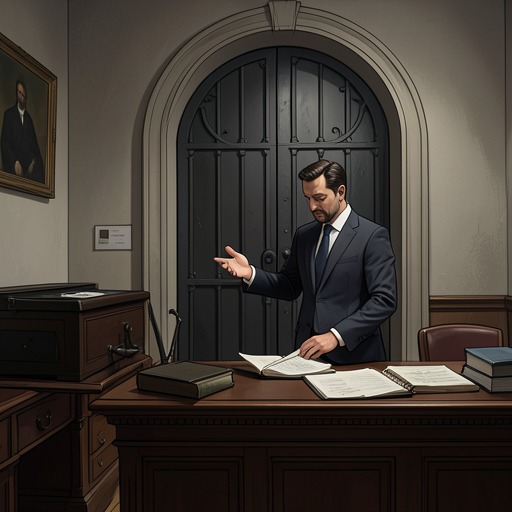
The RoomThe officers’ psychiatric commitment is the imagined legal and institutional reversal at the center of the Unnamed protagonist’s campaign against Harry and Fred. Instead of facing ordinary criminal accountability, the two officers are presented as emotionally unfit to serve, committed to a state mental institution, and subjected to a confinement the protagonist hopes to prolong. The sequence turns his grievance against police power into a story of authority redirected against its holders, while its movement between courtroom fantasy and later news report makes the status of the events uncertain.
Background and Motive
The commitment grows out of the Unnamed protagonist’s sustained distrust of police and legal authority. In his draft denunciation of a police state, he argues that obscure and antiquated laws give officers opportunities to harass citizens, and that an officer’s personal animosity can turn minor conduct into a pretext for enforcement. Elsewhere, he recalls being arrested for suspicion after becoming lost in an unfamiliar part of a city, despite offering identification, and describes the ensuing hours of questioning and processing as bewildering. At his own hearing, legal language registers as largely incomprehensible; he distrusts the appointed defender and prepares to identify weaknesses in the prosecution’s witnesses himself.
These experiences do not establish the officers’ commitment as a real-world judicial outcome. They help explain why the imagined proceedings take the form they do: the protagonist pictures official procedure as a tool that can be turned against the police, just as he believes it has been turned against him. His fantasy enlarges personal retaliation into a public campaign, with psychiatrists, a judge, and institutional authority enlisted to deliver a punishment unavailable to him in his actual position as a prisoner.
Proposed Finding of Unfitness
In the courtroom sequence, the proposed route to removing the officers from the force is psychiatric rather than a conventional prosecution. A speaker expresses confidence that a cursory examination would show the men to be unfit for police work and suggests that they would not contest dismissal if they were given to understand that criminal charges would not be pursued. The exchange also raises the prospect of postponing proceedings until psychiatric reports can be evaluated. The commitment therefore appears first as the projected consequence of an assessment of fitness for service, not as a verdict establishing criminal guilt.
The subsequent hearing gives that proposal institutional weight. Court-appointed psychiatrists describe the officers as emotionally disturbed and as capable of feeling justified in cruel and abnormal conduct. The protagonist listens to their testimony and inwardly celebrates the labels applied to the men, including their being characterized as hostile and unfit to serve. In his account, no defense is mounted against the psychiatric evidence. He attributes this silence to instructions given to the officers’ appointed attorney, who is said to fear damaging publicity during an election year and further public exposure of officials. That explanation belongs to the protagonist’s account of the proceedings; the narrative does not independently establish the officials’ motives.
Commitment and the Protagonist’s Retaliatory Design
At the close of the brief proceedings, the judge commits Harry and Fred to a state mental institution for an unspecified period. The protagonist regards the sentence not as a final resolution but as the start of a longer punishment. He imagines checking on the officers, requesting evaluations by independent psychiatrists, and making those assessments public so that the authorities would be reluctant to release them. His desired outcome is years of confinement in a locked ward with no privileges. The imagined sentence thus exceeds the immediate legal order: he wants continuing oversight and a public record that will keep the men confined.
His plans extend beyond the officers themselves. He imagines identifying them publicly after any eventual release and subjecting their families to social ostracism and repeated displacement. The scale and duration of this intended retribution are important to the scene: even a commitment of indefinite duration does not satisfy him, because he imagines punishment continuing both inside and beyond the institution. The sequence does not present this program as a measured reform of policing. It shows the protagonist recasting vengeance as justice and seeking to make institutional control answer, without limit, for the power he believes was used against him.
Silence, Confinement, and a Later Report
The officers do not protest when the sentence is imposed. The protagonist believes they have been warned that resistance could bring rape charges carrying the possibility of execution, and reads their silence as fear rather than acceptance. He watches their reactions and anticipates that their distress will worsen over time. These are his interpretations of their state of mind, not an independently verified account of what they think or what instructions they received.
A later newspaper story appears to give the commitment a further consequence. It reports that the recently committed officers ran amok in the institution, attacked personnel, and tried to escape through an office window and over a fence. They were stopped with a tranquilizer gun, treated for injuries, restrained, and placed in the hospital’s maximum-security wing. The report supplies no explanation for their behavior. The protagonist reads the account as confirmation that his plan is working and believes that the photographs he possesses can be used again to prevent their release. The newspaper’s account makes the institutional confinement seem to have effects beyond the earlier courtroom fantasy, but the surrounding narrative’s shifts between imagined triumph and apparent public events prevent a simple separation of fantasy from reality.
Narrative Significance
The commitment reverses the story’s earlier distribution of power: officers who had exercised authority over others become subjects of legal, psychiatric, and custodial decisions. Yet the reversal is not presented as an uncomplicated victory. Psychiatric descriptions serve the protagonist’s imagined campaign, and he treats confinement as an instrument of revenge rather than as care or an impartial response to a demonstrated condition. The institution’s language of emotional fitness also gives his fantasy a procedural plausibility that his more openly violent imaginings lack.
The episode is therefore significant both for what it claims to happen to Harry and Fred and for what it reveals about the Unnamed protagonist’s changing relationship to justice. He imagines himself converting his own exclusion from legal power into control over a public spectacle: proceedings, expert testimony, a sentence, press coverage, and continuing surveillance. But the promised victory depends on the same coercive systems he condemns. The commitment becomes the point at which his campaign against police abuse most clearly takes the form of its own punitive, controlling mirror.